Odoo has become one of the world's leading integrated business suites by bringing CRM, finance, commerce, inventory, manufacturing, HR, projects and service onto one connected platform. Melaya gives the integrators who know that platform the governed AI layer to turn their clients' business knowledge into production agents, without replacing the system that already runs the company.
Odoo reports 28 million users across organizations from startups to large enterprises, and describes its on-premise offer as the most installed business software in the world. Its public implementation directory lists more than 4,500 partners worldwide. That combination of scale, breadth and flexibility makes Odoo an exceptional foundation for business AI: agents can work across connected company processes instead of stopping at the boundary of each isolated app.
Those partners already have the relationships, process knowledge and implementation discipline that enterprise AI projects need. What many do not want to build from scratch is the agent runtime around the ERP: model routing, tools, permissions, memory, approval modes, evaluation, deployment and traceability.
That is the role Melaya is building for the Odoo ecosystem. Melaya connects directly to Odoo 19 through its JSON-2 API with 178 typed actions across CRM, purchasing, accounting, HR, projects, helpdesk, manufacturing, quality, marketing, documents, subscriptions, rental, point of sale and more. An Odoo integrator can turn a client's requirements into visual agents, keep the client relationship, and deliver a structured AI practice without rebuilding the infrastructure underneath it.
Melaya is now an approved Odoo Learning Partner. This is the first formal step in a relationship designed to grow with real implementations, trained teams and client outcomes. Odoo defines Learning Partner separately from its Ready, Silver and Gold Official Partner levels. We are starting at the correct stage, building the delivery evidence, and aiming much further: to help Odoo integrators become capable AI implementation partners for the clients they already serve.
The client keeps Odoo as the system of record. Odoo continues to enforce the access rights, record rules and field permissions of the dedicated API user. Melaya adds the Assistant, visual Agent Builder, explicit tool grants, approval modes, schedules, evaluations and replayable traces. The integrator brings the process expertise and implementation ownership. Together, those layers turn AI from a disconnected chatbot into a governed operating capability inside the client's real business system.
A new AI capability for the Odoo ecosystem
This is larger than connecting an API. It brings a governed AI delivery model to one of the world's most extensive business software ecosystems, through the people already responsible for making Odoo work inside thousands of companies.
- Trusted client relationships and implementation ownership
- Deep knowledge of each company's Odoo configuration and processes
- Functional expertise across finance, sales, inventory, HR and manufacturing
- Local delivery, change management and first-line support
- 178 typed Odoo actions plus connectors, Assistant and visual Agent Builder
- Templates and AI-assisted creation that shorten the first implementation
- Permissions, approval modes, evaluations and replayable traces
- Enablement, deployment flexibility and direct support for integrator teams
The commercial logic is simple. The Odoo integrator remains the primary client owner and expands its offer from ERP implementation into governed AI delivery. The client gets AI inside the workflows it already uses, with a team it already trusts. Melaya supplies the reusable technology and supports the integrator through discovery, pilot design, deployment and expansion.
- A structured AI discovery workshop tied to the client's real Odoo processes
- A governed pilot built from templates or drafted through AI-assisted pipeline creation
- A conversational Assistant that works across approved Odoo records and business connectors
- Reusable department packages for finance, sales, inventory, operations and service
- Local, enterprise-server or cloud model execution according to the client's privacy needs
- Ongoing optimization, support and expansion owned by the integrator
From a place you visit to a system that runs itself
The shift is quiet on the surface and large underneath. Instead of opening Odoo to check a number, you tell an agent the outcome you want, and it works inside Odoo to produce it.
- You state the outcomeIn the assistant or a saved Odoo pipeline
- The agent reads OdooPulls the real records: orders, bills, stock, invoices
- It reasons and draftsReconciles, summarizes, or prepares the next action
- Policy decides what can runOdoo permissions and the selected Melaya approval mode are both enforced
- The action is recordedEvery tool call and result stored as a span you can replay
Because Odoo actions are ordinary tool calls in the Melaya runtime, they compose with everything else. An agent that reads a purchase order in Odoo can, in the same pipeline, check the delivery email, cross-reference the two, and post a summary to your team chat. The ERP is no longer a walled garden. It is one more set of tools your agents can reach.
Odoo validates every call against the access rights, record rules and field permissions of the API-key user. Melaya then limits which Odoo tools the agent receives. Safe mode can hold write actions for approval, while reduced-approval modes are an explicit choice by the user or workflow owner. The agent cannot grant itself broader Odoo rights or new Melaya tools.
Concrete things you can build
For an Odoo integrator, these become concrete, repeatable offers rather than open-ended AI consulting.
Automated vendor bill and purchase-order reconciliation. An agent pulls the incoming vendor bills, matches each line against its purchase order and what actually arrived, flags the mismatches for a human, and clears the clean ones for your approval. The tedious three-way match becomes a short review.
Daily sales and project status reports. Every morning, a scheduled pipeline reads the day's pipeline movement, the new orders, and the stalled deals, then writes a plain-language summary to your inbox or your team channel. You start the day knowing where things stand without opening a single dashboard.
Inventory alerts and invoice follow-ups on autopilot. An agent watches stock levels against your thresholds and warns you before you run out, and a second agent drafts polite follow-ups for overdue invoices, holding each one behind your approval before it sends.
Manufacturing, service and people operations. The same connector covers bills of materials, work orders, quality checks, maintenance requests, field-service tasks, timesheets, leave, expenses, recruitment and appraisals. One Agent Builder can coordinate work that normally crosses several Odoo apps and several owners.
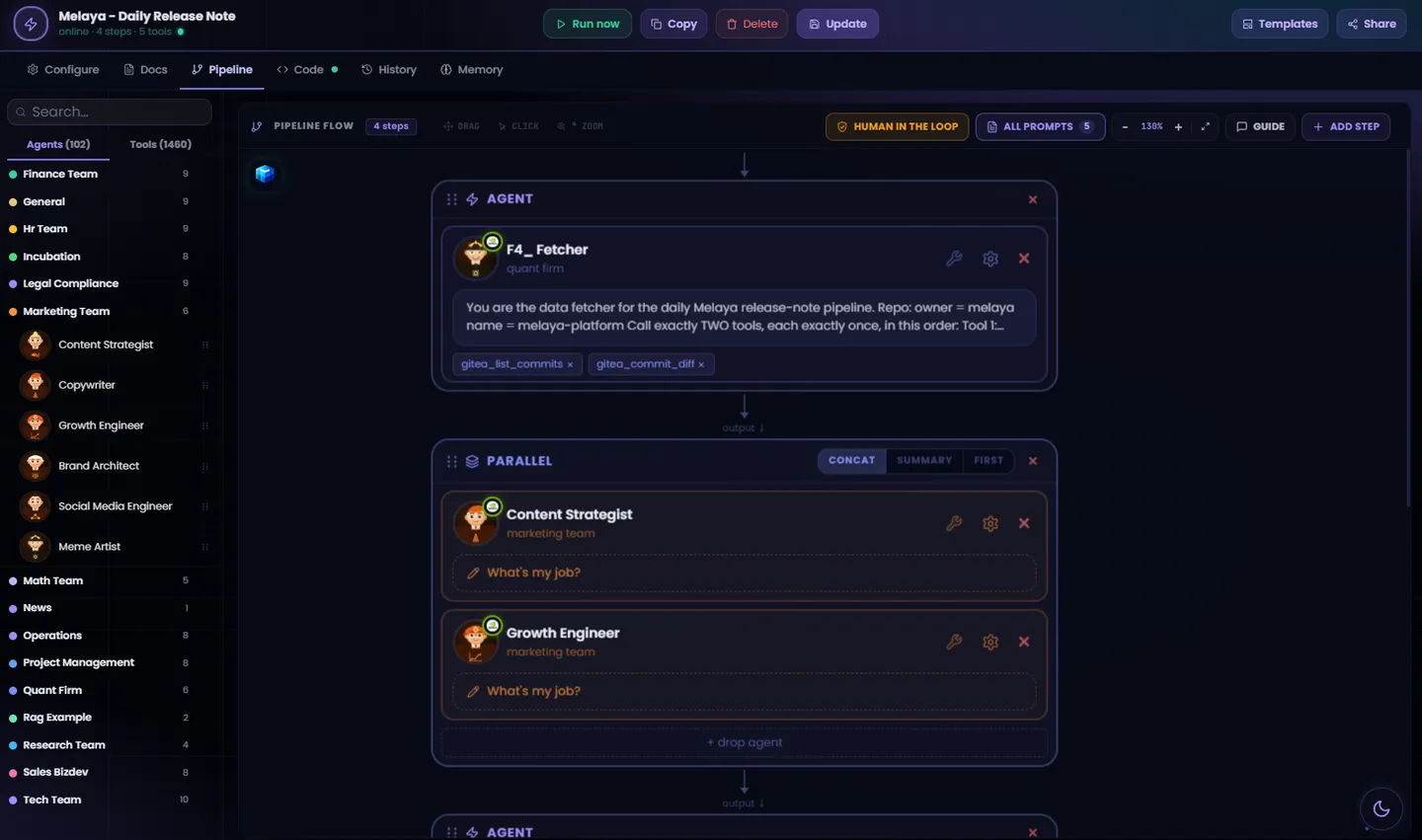
A recurring Odoo task deserves an agent. In the visual Agent Builder you connect the Odoo tools to a schedule and an approval gate on one canvas, so the monthly reconciliation or the daily report runs without you. Describe the workflow in a sentence and AI-assisted creation drafts the pipeline, then you review the structure before it ever touches a record.
What it means for you
If you are an Odoo integrator, Melaya lets you add a governed AI practice without spending years building the runtime. Start with one client workflow, use the existing 178-action integration, adapt a template or draft the pipeline with AI, and keep ownership of discovery, implementation and ongoing support. Melaya trains and supports your team behind the platform.
If your company runs on Odoo, you gain an AI layer that can coordinate complete processes instead of automating one screen at a time. Your integrator already understands your configuration and operating reality. Melaya gives that team the agent infrastructure to automate safely across Odoo and the rest of your stack, while Odoo remains the system of record.
For Odoo, the model creates a practical way for its integrator ecosystem to answer the next client question: how do we put structured AI into the business without discarding the ERP implementation we already trust? The Learning Partner relationship gives Melaya the right foundation to develop that opportunity responsibly, gather implementation evidence and grow the partnership from real outcomes.
For Melaya, the Odoo ecosystem is a path from one deep connector to thousands of AI-capable delivery teams. The launch announcement covers the platform end to end, and the Odoo partner page summarizes the integrator proposition.
Odoo integrators already know the business. Melaya gives them the governed AI layer to act on that knowledge, prove the outcome and lead their clients into the next operating model.
Do not replace the Odoo relationship. Make it AI-capable.
